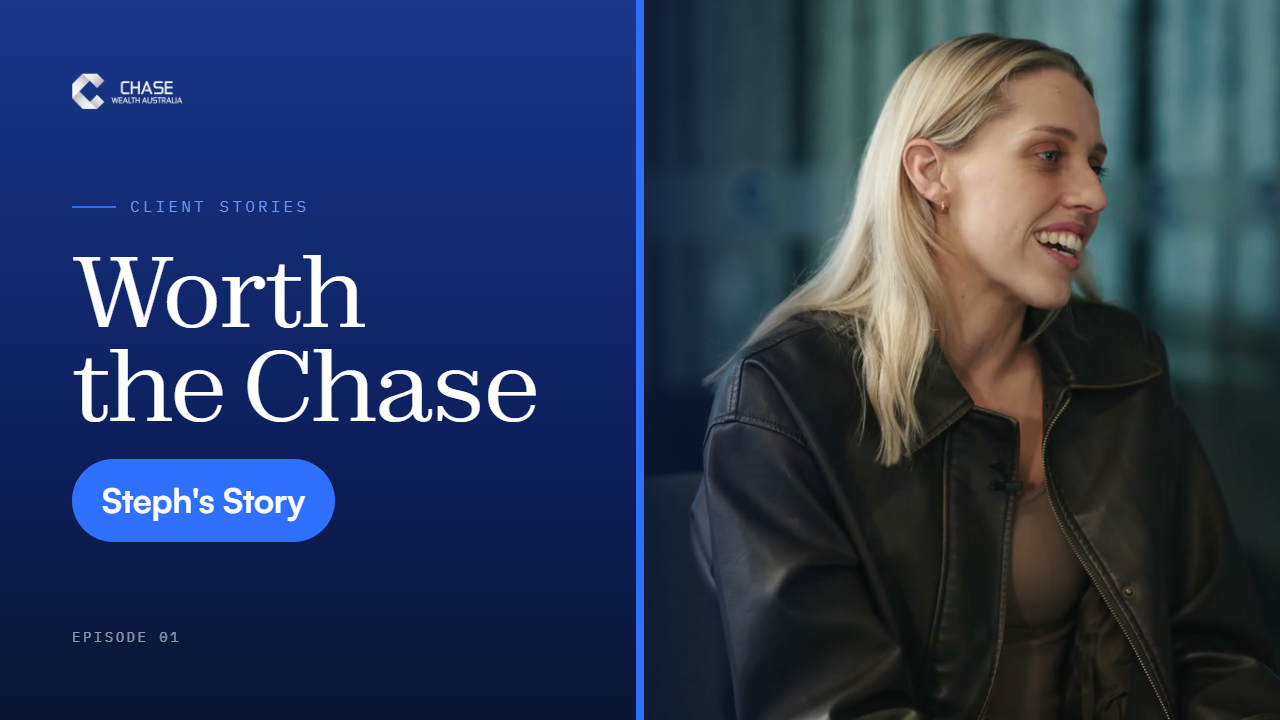
Worth the Chase is a series from Chase Wealth Australia where we sit down with real clients and let them tell their story, in their own words.
First up is Steph Hagan, a client since 2021 alongside her mum. Steph talks candidly about walking in apprehensive and skeptical, the questions she was not sure she even understood, and the pushback she got from people who thought she should just be doing it herself.
She covers the Bowen Hills apartments everyone told them were the wrong call, the capital growth Chase Wealth Australia said would happen and did, the knowledge she picked up along the way, and what it means now to watch her mum stage her way into a comfortable retirement.
This is an unscripted, full-length conversation rather than a highlight reel. Fees, risk and doubts are all in it. If you have ever wondered what working with Chase Wealth Australia actually looks and feels like from the client’s side, this is it.
It looks like Steph, who came in straight off a night shift as a nurse to sit beside her mother, and whose first internal question was who these people were and what they wanted. She says plainly that property was not her field and that she did not always know what the words meant. Catherine Andrews treats that skepticism as the correct response rather than a problem, and says the questions it produced were the ones that keep Chase Wealth Australia honest, because they force the conversation back to the client's side of the desk.
From outside the meeting. Asked whether doubts crossed her mind afterwards, Steph is specific: the biggest thing was other people. Her own questions had been answered and then explained a second way. What followed was the familiar external version, that you could do this yourself, cheaper, faster, somewhere else. Her answer to that is that this is not her field, it is someone else's, and what she was paying for was the strategy and the precision behind the plan.
Because the decision was made on yield and growth rather than on floor area. Steph and her mother bought in an inner Brisbane suburb, and the reaction from people around them was that the same money would have bought several times the property somewhere further out. The reasoning given is rental yield and what the position was expected to do over time. It is a good example of a decision that looks wrong on the metric people reach for first and right on the metric that was actually being used.
By putting it next to the transaction rather than next to your weekly spending. The comparison Steph makes is with paying someone to do something you could technically do yourself: the fee looks large in isolation and small against a purchase measured in hundreds of thousands of dollars. Catherine Andrews adds the qualifier that matters, which is that nobody is right every time, and that the first job on any area is to look for the reason not to buy there.
One decision at a time, with a gap between them. Rather than selling everything at once, Steph's mother is releasing one position, seeing what it produces, then waiting before making the next decision. Catherine Andrews describes this as the part she most wanted to highlight, because the instinct at retirement is usually to convert the whole portfolio in a single move. Staging it keeps the remaining assets working while the plan is still being executed.
The stated goal was always there and the route was not. Steph puts it as wanting to do this for a long time without knowing how, and says what they were given was the how. Her mother had rebuilt her position more than once, moved careers, and was setting up for retirement while managing her health. The outcome Steph names is that her mother expects to retire comfortably, and that a foundation now exists for Steph and her partner as well.
That the risk is real and the question is which risk you are taking. Steph does not argue that the doubt is misplaced, and says people should want to know what they are taking on. Her point is that working and never getting to the part you worked for is also an outcome, and one that arrives by default rather than by decision.
"And it's something that we've always wanted to do. We just haven't really known how. And I guess you guys have given us the how."
Steph, 0:08
"People aren't just meant to work 24/7 and die."
Steph, 0:12
"I was skeptical. 100% I was skeptical, but for good reason. Like there's always risk. And I think it's just about finding the right type of risk."
Steph, 22:13